
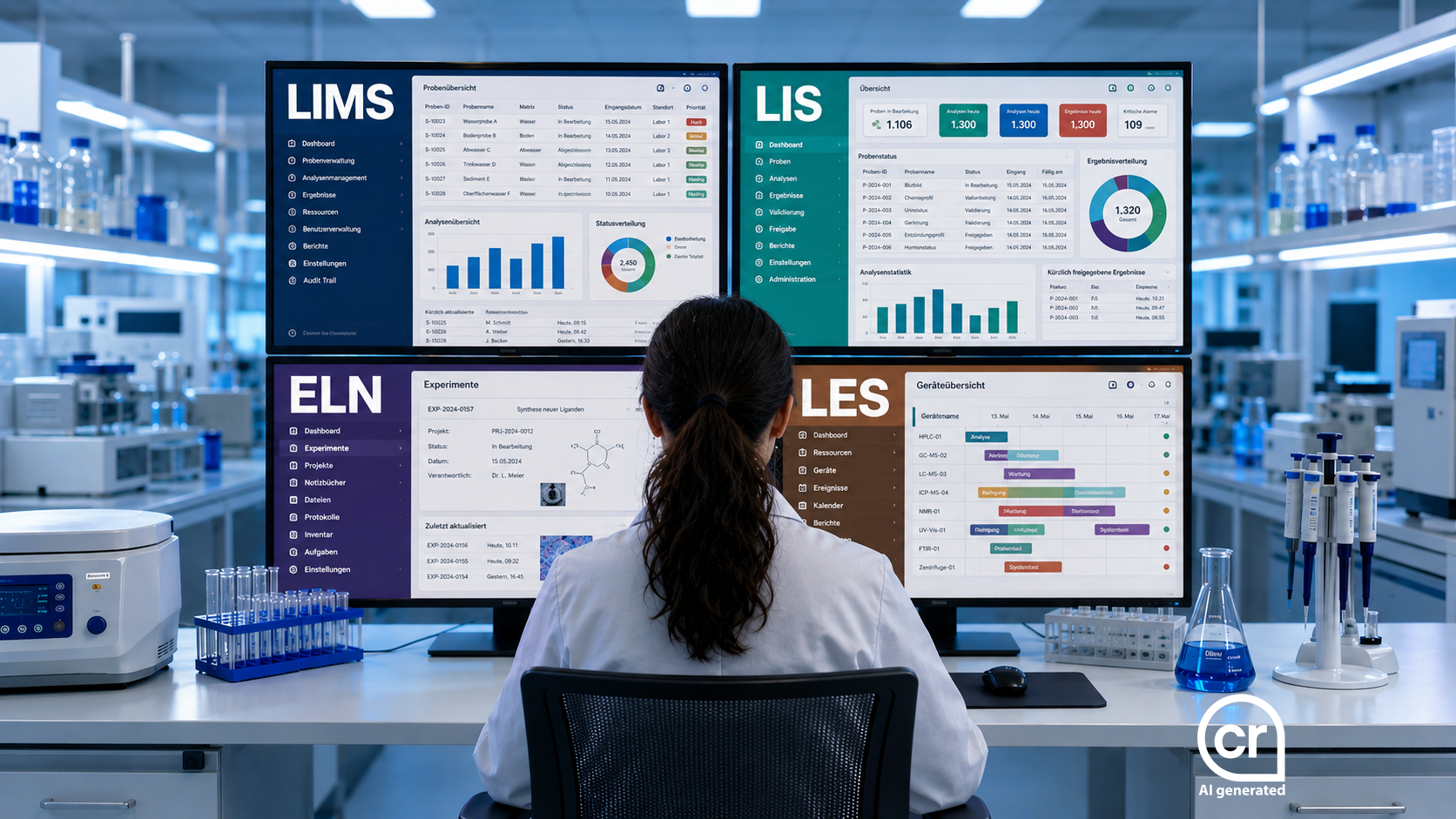
The different classes of laboratory systems
Laboratory software is typically divided into four classes in the specialist literature: 1. the sample-centered LIMS for the central administration, tracking and documentation of laboratory processes, 2. the clinically oriented LIS for the administration of patient data and laboratory orders, 3. the digital laboratory notebook ELN for the flexible and free documentation of tests and experiments and 4. the LES for the step-by-step, assisted execution of tests – supplemented by 5. hybrid systems, such as SAMPLES (www.samples.de) from qualitype GmbH, which combine the functions of several classes.
Which laboratory software is most suitable in each case therefore depends on the specific needs, requirements and area of application. Although all four system classes manage laboratory and measurement data, they differ significantly in terms of their scope and the extent of their functionalities. The following classification provides a quick overview and characterizes the various laboratory systems:
1 LIMS: What is a laboratory information and management system?
A LIMS is a sample-centered software for the central management, tracking and documentation of laboratory processes, such as sample processing, analysis orders, measurement data and laboratory resources. A LIMS digitally controls laboratory workflows and fulfills regulatory requirements for traceability and quality assurance. The areas of application of a LIMS are diverse, from research and industrial analysis to quality assurance in production and water and environmental analysis. The core functions of a LIMS typically include sample management, device integration and management, audit trail and documentation as well as the creation of test reports and certificates of analysis.
This means that a LIMS can be used more extensively than an LIS, as it is also suitable beyond clinical use. The LIMS is also broader in comparison to the ELN, as it includes sample management, among other things. In most cases, however, a LIMS does not offer assisted execution of tests in the sense of SOPs (standard operating procedures), as an LES does. Hybrid systems such as the LIMS SAMPLES (www.samples.de) are an exception (see point 5), which include the functionalities of several classes.
2 LIS: What is a laboratory information system used for?
An LIS is a clinically oriented software for managing patient data, laboratory orders and medical findings in a diagnostic environment. An LIS is therefore mainly used in clinical laboratories in hospitals and medical facilities. The core functions primarily include patient and order management, connection to HIS (Hospital Information System), transmission of findings and billing integration.
In contrast to LIMS, ELN and LES, an LIS is clearly clinically specialized and patient-centered. This is why, in contrast to the other systems, it has a special integration of HIS (Hospital Information System) or HIS (Hospital Information System). On the other hand, an LIS usually does not offer ELN and LES functions (laboratory notebook, step-by-step instructions / SOPs).
3 ELN: What is an Electronic Lab Notebook?
An ELN is a kind of digital version of the classic paper lab book used in science and research. An ELN is used in particular for the flexible and free documentation of tests and experiments. An ELN is therefore primarily used in academic and industrial research and development. The core functions of an ELN typically include structured and unstructured experiment documentation, collaboration and comment functions as well as logging and integration of file attachments.
ELN systems are generally more lightweight and less expensive than LIMS or LIS, but have a smaller and very specific range of functions. However, some LIMS systems also offer integrated ELN functionalities. These include, for example, the award-winning laboratory management system SAMPLES (www.samples.de), which is also referred to as a hybrid system (see point 5).
4 LES: What is a lab execution system used for?
An LES is software for the step-by-step, assisted execution of experiments according to a predefined, standardized workflow or SOPs (Standard Operating Procedures). An LES controls and documents the step-by-step execution of laboratory processes in real time and often functions as a further development or supplement to the ELN. An LES is primarily used in regulated environments with a high need for standardization, such as GMP (Good Manufacturing Practice), quality control or biotechnology production. The core functions of an LES include digital step-by-step instructions, electronic approvals and compliance documentation in accordance with 21 CFR Part 11 (Code of Federal Regulations).
The focus of the LES is on active process control (SOPs), while an ELN, for example, is primarily used for documentation. An LES is also rather lean and does not include general data management like a LIMS or LIS. With LES, the focus is on regulatory-compliant execution rather than archiving or documentation as with LIMS, LIS and ELN. LES functionalities are already integrated in selected LIMS, such as SAMPLES (www.samples.de) (see hybrid systems below).
5. What are hybrid laboratory systems?
Hybrid systems combine the characteristics and functionalities of several classes and therefore cannot be assigned to a single laboratory system class as a pure LIMS, LIS, ELN or LES. Hybrid systems usually have a modular, scalable structure and uniform data storage without media discontinuity. The biggest advantage of hybrid systems is that all data and results are available in a single system – and can also be maintained, processed and documented. Hybrid systems are attractive for laboratory staff because they only have to familiarize themselves with a single system for their daily work. SAMPLES (www.samples.de) is also one of these hybrid systems and even combines the functionalities of all four classes.
And which is the best LIMS or hybrid laboratory software?
Even if this question is difficult to answer – and based on the individual use case – SAMPLES (www.samples.de) from qualitype GmbH is certainly one of them, as it was voted “Product of the Year 2025” in the laboratory software category by readers of the trade magazine LABO.de (https://www.labo.de/it-im-labor-laborautomation/managementsystem-samples.htm). What makes SAMPLES so special is its modern, open software architecture, maximum adaptability to individual requirements and a wide range of smart functions and features that guarantee effective day-to-day laboratory work – even for complex laboratory processes. More can be found here: https://samples.de/features
Quick overview: LIMS, LIS, ELN and LES in comparison
LIMSLaboratory Information | LISLaboratory | ELNElectronic | LESLaboratory | Hybrid systemssuch as SAMPLES | |
Focus |
|
|
|
|
|
Typical users |
|
|
|
|
|
Strengths(in comparison) |
|
|
|
|
|
Weaknesses |
|
|
|
|
|
Fokus
LIMS
Laboratory Information Management System
- probenzentriert
- Daten- & Prozess-management
- Qualitätssicherung & Compliance
LIS
Laboratory Information System
- patientenzentriert
- klinisch-diagnostisches Umfeld
- KIS/HIS-Integration
ELN
Electronic Laboratory Notebook
- dokumentationszentriert
- freie Forschungsdokumentation
- FAIR-Datenprinzipien
LES
Laboratory Execution System
- prozesszentriert
- digitale Schritt-für-Schritt-Anleitungen
- Compliance gemäß 21 CFR Part 11
Hybrid systems
such as SAMPLES
- incl. the focus of the respective integrated systems
- Holistic consideration of laboratory processes
- Flexible use across all laboratory areas
Fokus
LIMS
Laboratory Information Management System
- probenzentriert
- Daten- & Prozess-management
- Qualitätssicherung & Compliance
LIS
Laboratory Information System
- patientenzentriert
- klinisch-diagnostisches Umfeld
- KIS/HIS-Integration
ELN
Electronic Laboratory Notebook
- dokumentationszentriert
- freie Forschungsdokumentation
- FAIR-Datenprinzipien
LES
Laboratory Execution System
- prozesszentriert
- digitale Schritt-für-Schritt-Anleitungen
- Compliance gemäß 21 CFR Part 11
Hybrid systems
such as SAMPLES
- incl. the focus of the respective integrated systems
- Holistic consideration of laboratory processes
- Flexible use across all laboratory areas
Fokus
LIMS
Laboratory Information Management System
- probenzentriert
- Daten- & Prozess-management
- Qualitätssicherung & Compliance
LIS
Laboratory Information System
- patientenzentriert
- klinisch-diagnostisches Umfeld
- KIS/HIS-Integration
ELN
Electronic Laboratory Notebook
- dokumentationszentriert
- freie Forschungsdokumentation
- FAIR-Datenprinzipien
LES
Laboratory Execution System
- prozesszentriert
- digitale Schritt-für-Schritt-Anleitungen
- Compliance gemäß 21 CFR Part 11
Hybrid systems
such as SAMPLES
- incl. the focus of the respective integrated systems
- Holistic consideration of laboratory processes
- Flexible use across all laboratory areas
Fokus
LIMS
Laboratory Information Management System
- probenzentriert
- Daten- & Prozess-management
- Qualitätssicherung & Compliance
LIS
Laboratory Information System
- patientenzentriert
- klinisch-diagnostisches Umfeld
- KIS/HIS-Integration
ELN
Electronic Laboratory Notebook
- dokumentationszentriert
- freie Forschungsdokumentation
- FAIR-Datenprinzipien
LES
Laboratory Execution System
- prozesszentriert
- digitale Schritt-für-Schritt-Anleitungen
- Compliance gemäß 21 CFR Part 11
Hybrid systems
such as SAMPLES
- incl. the focus of the respective integrated systems
- Holistic consideration of laboratory processes
- Flexible use across all laboratory areas